
Episode
You Announced the Hire Before They Said Yes
Get the announcement right.
ListenQuick answer
Onboarding a new church staff member starts the day they say yes and runs through their first 90 days. Plan four stages: before they arrive, day one, week one, and the first 90. Name one person to own the plan, care for the family as well as the hire, and hold real conversations at 30, 60 and 90 days.

By Todd Rhoades, Co-founder, Chemistry Staffing
When someone accepts your job offer, it's time to celebrate. But it's not time to unplug. You can have the best search process on Earth. But if you don't onboard your new staff member well, the odds of a long-term, healthy fit go down from day one.
The good news is, the whole plan is below, with a checklist you can print.
A church staff onboarding playbook is a written plan for a new staff member's first 90 days. It says what happens, when, and who owns it.
Orientation is a day or two: the paperwork, the building tour, the keys. Onboarding is the whole first season, when a new staff member learns your culture, builds relationships and gets clear on what a win looks like. Keys are not a plan.
Your search isn't over at "yes," either. The goal of a search isn't a yes. It's a healthy long-term fit.
You can run a great search and still lose a great hire in the first year. A new staff member may be moving a family, leaving a church they loved, and learning a culture nobody wrote down. A clear plan, an honest history, and regular conversations tell them they belong here.
Treat onboarding as the last stage of your search, not an afterthought. Before they arrive, announce the hire the right way, finish the paperwork, get their office and accounts ready, and help the family with the move. Make day one feel expected. In week one, introduce them one-on-one, tell them the history of their ministry, and set a meeting rhythm. Then put conversations on the calendar at 30, 60 and 90 days.
| Stage | When | The goal | Owner | Must-dos |
|---|---|---|---|---|
| Before they arrive | From "yes" to the night before | A ready office and a cared-for family | Lead | Announcement, paperwork, working tools, the move, first-week schedule |
| Day one | The first day | They feel expected | Supervisor | Someone at the door, check-in, welcome lunch, debrief |
| Week one | The first week | Relationships and the real story | Supervisor and guide | One-on-one introductions, the history, a meeting rhythm |
| The first 90 | After week one, through day 90 | Clarity, healthy rhythms, an honest look at fit | Supervisor and lead | Conversations at 30, 60 and 90 days, coaching, first-year goals |
This stage is easy to skip. The hard part feels done. It isn't.
Staff hear first, then the congregation. The bigger rule is timing: don't announce the hire until they actually say yes and have resigned well where they are.
File the offer letter, and finish the background check if the search didn't. Set up payroll, benefits, and the tax and employment forms. Share the vacation and sabbatical policy in week one. For ministers, designate the housing allowance before the first paycheck. Send the employee handbook ahead of time.
When someone arrives, give them a church card, not a request to use theirs.
Give them a clean office, not the last person's stuff. Computer, email, phone, keys and church management software should all work before they walk in.
Name one local contact for questions about schools, doctors and a good mechanic. Arrange a welcome team for the moving truck. Send a note to the spouse and kids.
Plan the first week day by day. Then write one sentence that describes a win at the end of year one. Ideally you'd write the year-one win before you post. If you didn't, do it now.
First impressions are a big deal. Have someone waiting at the door, and make sure the supervisor is there. Start with a short morning check-in and end with a debrief. Introduce them around, take them to a welcome lunch that isn't about work, and hand them a little church swag.
Keep the day light on tasks. You want them to drive home thinking, "They were ready for me."
Week one is when new patterns form and the first-day excitement fades.
Set up one-on-one introductions with key staff and volunteer leaders, not one big group hello. Name a guide who can answer "How do things really work here?" Make it a peer, not the boss.
Then tell them the history. Who led this ministry before? What was tried? What were the hard parts? If it's a ministry nobody else wanted, say so, and give them permission to change it. Tell them in week one, not month six.
By week's end, set a one-on-one rhythm and put the 30-, 60- and 90-day conversations on the calendar.
Use their outside perspective, help them set healthy rhythms, and keep your interview promises. Write these conversations on the calendar, or they won't happen.
Are they clear on the work, not just the job description? Do they have what they need, and someone to ask?
Ask, "What are you learning? What are you seeing that we don't see?" Their fresh eyes fade fast.
Ask, "How are you doing? How is your family adjusting? How can we help?" Then agree on two or three goals for the first year.
Don't save the first real feedback for the annual review. Praise and drive-bys aren't coaching. Every couple of weeks, talk briefly about one thing that's working, one thing to adjust, and what "good" looks like next.
When you hire someone with a family, the whole family moves. They may be selling a house, enrolling kids in a new school, and saying goodbye to a church they loved. A spouse may have left a job and close friends behind. There's real loss tucked inside a happy move, so go gently. You aren't just hiring them. You're adopting them into your church family.
Name one person who checks on the family in the first month. Invite them into church life with a small group, a meal, and a few friendly faces on Sunday. Just don't make them a project. Let them settle at their own pace.
And remember that your new hire needs a place to be a worshiper, not just a worker. Help Sunday stay church for them and their family, not just a shift.
At the 90-day conversation, step back together and revisit the five essentials of a healthy long-term fit: Theology, Church Culture and DNA, Personality, Skills and Abilities, and Chemistry. They're the same five you hired for.
Make it a two-way conversation. Ask, "What are we each learning?" Where does the fit feel strong? Where is it harder than you expected? Invite your new staff member to ask you the same questions.
It isn't a pass-or-fail verdict. A gap caught at 90 days is a conversation. A gap found in year three is a resignation.
You don't need an HR department. You need one person who leads the whole plan and holds everyone to their part.
| Role | Who it might be | What they own |
|---|---|---|
| Lead | Executive pastor or church administrator | The whole plan and the family's welcome |
| Supervisor | The person they report to | The relationship and the check-ins |
| Office or HR | Office manager or bookkeeper | Paperwork, payroll and benefits |
| Facilities and tech | Facilities lead or a handy volunteer | Office, keys and accounts |
| Guide | A peer on staff | "How things really work here" |
In a small church, one person may wear three hats. Just write down whose is whose.
The same four stages apply, but the board or elders own the plan. Introductions, the church's history and care for the family matter even more. Here's how to plan a senior pastor transition.
Announcing the hire before they say yes.
Handing them keys and disappearing.
Giving them the ministry nobody else wanted, without the history.
Saving their first real feedback for the annual review.
Treating orientation as onboarding.
A miss means doing the search and the onboarding twice. Here's what a bad church hire costs.
The whole playbook on one page, with an owner for every item.
| Stage | Task | Owner |
|---|---|---|
| Before they arrive | ☐ Announce after yes: staff, then congregation | Lead |
| ☐ Offer letter, personnel file, background check | Office or HR | |
| ☐ Payroll, benefits, forms, housing allowance | Office or HR | |
| ☐ Office, keys and accounts ready | Facilities and tech | |
| ☐ Local contact named; welcome team for the moving truck | Lead | |
| ☐ Note to the spouse and kids; first-week schedule written | Lead | |
| Day one | ☐ Someone at the door; introductions | Supervisor |
| ☐ Check-in, welcome lunch, debrief | Supervisor | |
| Week one | ☐ One-on-one introductions and the history of their ministry | Supervisor |
| ☐ Meeting rhythm set; 30/60/90 conversations calendared | Supervisor | |
| The first 90 | ☐ 30/60/90 conversations; coaching every couple of weeks | Supervisor |
| ☐ Check on the family; welcome them into church life | Lead | |
| ☐ Five-essentials fit check; first-year goals | Lead and supervisor |
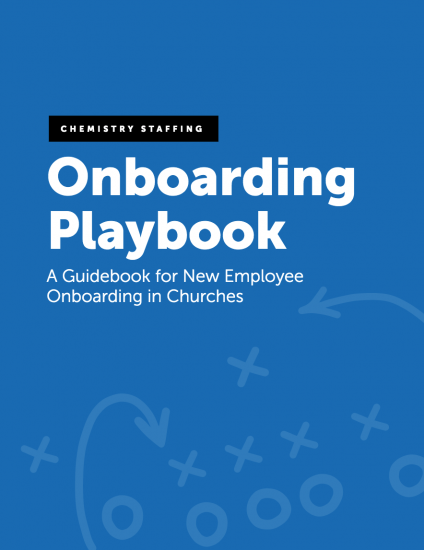
Get the printable checklist
Our goal in every search is a healthy long-term fit of at least five years, and onboarding is where that starts. That's a goal, not a promise. Candidates complete a pre-interview assessment that gathers 125 data points across theology, church culture and DNA, personality, and skills and abilities. That typically screens out 90 to 95 percent of applicants before a church interviews anyone. We present qualified candidates in batches of one to five, from a network of nearly 30,000 candidates. Our interviewers are current or former pastors and church staff. Here's more on what a church search firm does.
Let's hear your story and see if it makes sense for us to help.
Four stages with an owner for each: before they arrive, day one, week one, and the first 90 days. Include the paperwork, a ready office and accounts, help with the move, a first-week schedule, one-on-one introductions, the history of their ministry, a meeting rhythm, and conversations at 30, 60 and 90 days.
Plan on 90 days, starting the day they accept your offer. Orientation, the paperwork and building tour, takes a day or two. Onboarding is the whole first season: learning the culture, building relationships, and getting clear on what a win looks like. Finish with a 90-day conversation and first-year goals.
One person should lead the whole plan, usually the executive pastor or the church administrator. The supervisor owns the relationship and the check-ins. The office handles paperwork and payroll, facilities handles the office and accounts, and a peer guide answers the "how do things really work here" questions. One owner keeps it from falling through the cracks.
At 30 days: Are you clear on the work, and do you have what you need? At 60 days: What are you learning, and what are you seeing that we don't see? At 90 days: How are you doing, how is your family adjusting, and how can we help?
Name someone to help with the move and to answer questions about schools, doctors and the community. Send a note to the spouse and kids, and meet the moving truck with a few volunteers. In the first months, ask how the family is adjusting, and help them find a place to belong and worship, not just work.
The same four stages apply, but the board or elders own the plan, and the stakes are higher. Introduce the new pastor to key leaders and the church's history, including the hard parts. Support the family, and schedule check-ins through the first year, not just when problems come up.
Three Healthy Church Staff Podcast episodes:
Hiring a relative? Settle the family-hire guardrails before they arrive.
Just made a hire, or about to? Let's talk it through.
Let's hear your story and see if it makes sense for us to help.
Book a free 30-minute Zoom consult